If you’ve ever stepped outside on a hot day in Cebu, Manila, or anywhere in the Philippine lowlands and felt like the air itself was suffocating you — you already understand heat index intuitively. But if your weather station is showing you a temperature of 34°C and you think that’s the whole story, you’re missing the most important number.
Temperature vs. Heat Index: What’s the Difference?
Air temperature measures how hot the air is. Heat index — sometimes called “feels like” temperature — measures how hot it actually feels to the human body when you factor in humidity. High humidity prevents sweat from evaporating efficiently, which is your body’s primary cooling mechanism. When humidity is high and temperature is high at the same time, the compounded effect on the human body is significantly more dangerous than either factor alone.
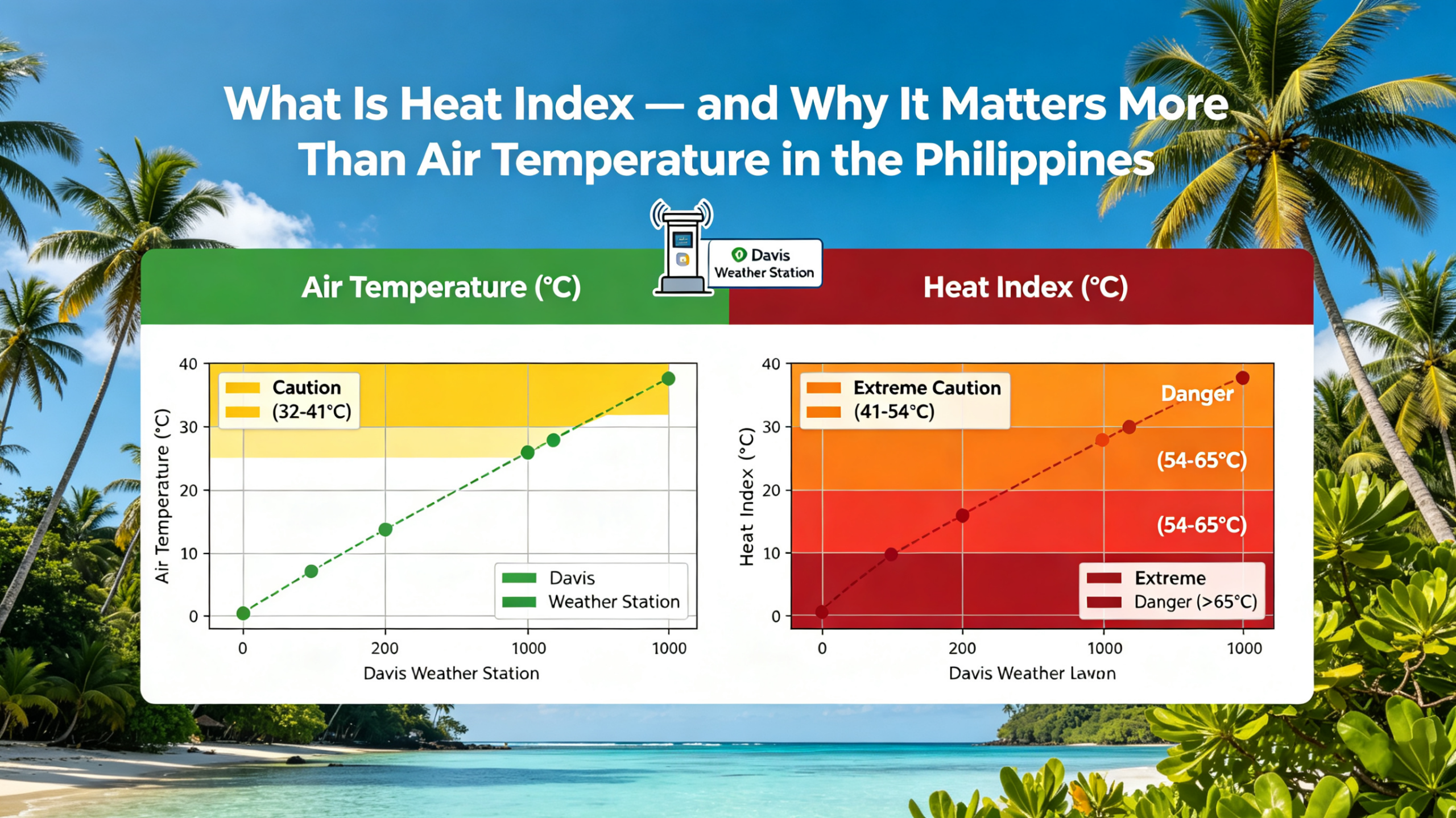
Here’s a simple example: a 34°C air temperature at 70% relative humidity produces a heat index of approximately 44°C. That’s a 10-degree difference — and it’s the 44°C that determines whether outdoor workers are at risk, not the 34°C.
Heat Index Danger Zones
PAGASA and international weather agencies use heat index thresholds to classify risk levels. As a general reference:
- 27°C – 32°C — Caution. Fatigue is possible with prolonged exposure or physical activity
- 33°C – 41°C — Extreme Caution. Heat cramps and heat exhaustion are possible
- 42°C – 51°C — Danger. Heat cramps and exhaustion are likely; heat stroke is possible with prolonged activity
- 52°C and above — Extreme Danger. Heat stroke is highly likely
In the Philippines, it’s not unusual for heat index values to reach the Danger range during the dry season — particularly in Visayas and Mindanao from March to May.
Why Your Davis Weather Station Is the Best Tool for This
Unlike PAGASA readings or national weather apps that report conditions at airport stations or regional observation points, your Davis weather station measures the heat index at your exact location — your farm, your school campus, your property. Hyperlocal data matters because heat index can vary significantly across short distances depending on shade, airflow, and ground cover.
If your station is connected to WeatherLink.com, you can see live heat index readings in your dashboard. But seeing it isn’t enough — you need to be notified the moment it crosses a threshold that matters for your situation, even if you’re not watching the screen.
Setting a Heat Index Alert in WL Alert
This is exactly what WL Alert was built for. You can create a rule that monitors your station’s heat index in real time and sends you an SMS or email the moment it crosses your chosen threshold — whether that’s 40°C for a school’s outdoor activities policy, or 42°C for a farm’s worker safety protocol.
Setup takes under five minutes:
- Connect your WeatherLink account to WL Alert
- Create a new alert rule — select your station and choose “Heat Index” as the metric
- Set your threshold (e.g., greater than 42°C)
- Add your recipients — SMS and/or email
- Write a custom message with placeholders like
{{value}}and{{station_name}} - Save the rule — WL Alert starts monitoring immediately
A Note on Philippine Networks
WeatherLink has a built-in alarm system, but its SMS delivery is not available in the Philippines. WL Alert was built specifically to fill that gap — using an SMS gateway that works on Globe, Smart, DITO, and other local networks. So whether you’re in Metro Manila, Cebu, Davao, or a rural farming province, your heat index alert reaches your phone.
If you own a Davis weather station and want to start monitoring heat index with automatic SMS alerts, WL Alert’s Free plan is a good place to start — no credit card required.